.webp) karingame.com
karingame.comDeconstruction of Strategic Synergies in Mario & Luigi™: Brothership Combat Architecture

The Evolution of Dual-Hero Turn-Based Mechanics in Concordia
The combat architecture of Mario & Luigi™: Brothership represents a fundamental design evolution within the turn-based RPG genre, moving away from passive command selection toward an intricate system of dynamic execution and spatial coordination. Set across the fractured continent of Concordia, the game replaces isolated character turn orders with a unified dynamic rhythm where every offensive and defensive action depends on dual-character synergy. This shift changes how players evaluate turn efficiency, character positioning, and resource management during prolonged encounters.
Unlike traditional turn-based frameworks where character abilities execute independently based on speed thresholds, Brothership ties Mario and Luigi into a shared structural framework. Player inputs dictate not only execution power but also positional safety and counter-attack opportunities. The game establishes a system where timing, positioning, and build-crafting intersect, forcing players to master spatial mechanics alongside long-term strategic resource allocation.
Core Operational Principles of the Kinetic Turn-Based Matrix
At the center of Brothership's combat system is the Kinetic Action Command system, which transforms standard menu commands into timing-dependent challenges. Every fundamental action—from basic Jump and Hammer attacks to elaborate evasive maneuvers—requires precise button inputs assigned exclusively to Mario (A Button) and Luigi (B Button). Executing these commands increases damage output while mitigating or completely negating incoming enemy damage through active counter-attacks.
This mechanics setup removes the concept of passive damage intake found in standard RPGs. Success relies on analyzing visual cues, processing enemy telegraphs, and executing button sequences across two characters simultaneously. The engine rewards mechanical precision with critical multipliers, status application, and immediate turn-advantage shifts.
Spatial Dynamics and Dual-Controller Inputs
Combat encounters occur on a three-dimensional plane where enemy positioning, airborne trajectories, and ground hazards dictate valid attack patterns. The spatial distance between the Mario Bros. and their targets dictates the animation window and timing adjustments required for Action Commands.
Engine Execution Windows
The precise timing windows for Action Commands vary based on distance and attack type:
- Standard Jump Commands: Requires primary input upon initial contact, followed by a secondary input at the height of the bounce to maximize damage.
- Hammer Smash Commands: Demands a pre-charge input held until the hammer head flashes, followed by a release command just before impact.
- Dual Counter-Maneuvers: Demands split-second spatial awareness, as incoming attacks target specific brothers based on enemy movement patterns and visual tells.
Anatomy of the Action Command System and Timing Windows
Precision in Mario & Luigi™: Brothership is measured through strict input timing brackets that evaluate player reactions down to the frame level. Attack evaluations range from 'OK' and 'Good' to 'Great' and 'Excellent', directly altering damage scaling, status buildup, and secondary effect activations. Achieving an 'Excellent' rating is not merely a bonus for higher damage; it serves as the primary activation trigger for complex Battle Plug interactions and gear-based combat mechanics.
The defensive layer operates under similar precision frames. Unlike traditional RPGs where defense is a passive status command, defense in Brothership requires real-time dodging or counter-attacking. A successful dodge completely avoids enemy damage, while a frame-perfect counter-attack damages the attacker and can cancel multi-hit enemy turn strings.
Frame Precision and Evaluation Thresholds
The game processes inputs by categorizing them into distinct evaluation windows during attack and defense animations. The temporal window for achieving an 'Excellent' input generally spans between 3 to 6 frames at 30 frames per second, requiring muscle memory and visual identification of enemy hitboxes.
Failing an Action Command drops damage output to base levels and prevents secondary equipment effects from triggering. On defense, failing a timing window results in full damage consumption and potential status ailments like Glohm, Burn, or Dizzy, which can disrupt character turn order and action availability.
Defensive Counter-Attacks vs. Emergency Guards
When facing complex enemy attack patterns, players must choose between two distinct defensive strategies:
- Active Jump/Hammer Counters: High-risk, high-reward responses that completely void damage and strike the attacking enemy, potentially ending their turn immediately.
- Emergency Guard System: A mitigation mechanic activated by holding down defensive inputs. While it eliminates the possibility of performing a counter-attack, it significantly reduces incoming damage and prevents knock-out blows during unfamiliar attack telegraphs.
Synergistic Battle Plug Architecture and Customization Matrix
The Battle Plug system introduces build-crafting depth to Mario & Luigi™: Brothership. Unlocked through Sprite Bulb collection and crafted using Lumenade, Battle Plugs act as passive and conditional modifiers that drastically alter combat rules. Players equip these plugs into a limited set of active sockets, creating passive buffs, elemental extensions, or area-of-effect expansions.
Battle Plugs do not offer permanent passive boosts; instead, they operate on a limited charge system. Each plug possesses a specific number of active turns or trigger charges before entering a mandatory cooldown state. This design choice prevents static setups, forcing players to rotate plug combinations and manage charge meters alongside standard health and Bros. Points (BP).
Plug Charge Mechanics and Cooldown Management
Every active Battle Plug consumes one charge per turn or per trigger event. Once depleted, the plug becomes inactive for a set duration, requiring strategic turn planning. Players can manage this resource loop using specialized utility plugs like Charge Bank or Countdown to Charge, which manipulate plug cooldown durations during active combat.
Understanding charge depletion cycles is essential for boss encounters. Depleting high-impact defensive or offensive plugs right before a boss's power phase can expose the party to massive damage or leave them unable to break enemy shields.
Advanced Battle Plug Combos
Combining compatible plugs in adjacent slots triggers unique combo effects that outperform individual plug abilities. These synergies change standard target profiles into broad elemental strikes or tactical crowd control setups:
| Plug Combination | Component Plugs | Synergy Effect | Tactical Application | | :--- | :--- | :--- | :--- | | **Surprise Iron Boost** | Attack Boost + Surprise Iron Ball | Spawns additional heavy iron balls upon landing attacks. | High single-target armor shredding and boss burst damage. | | **Statusplosion** | Kaboom Attack + Status Plug (Fiery/Icy/Dizzy) | Propagates single-target status ailments across all active enemies via shockwaves. | Multi-target crowd control and area-of-effect elemental buildup. | | **Tri-Elemental Tornado** | Dizzifying + Fiery + Icy Attack | Generates a multi-elemental vortex dealing immense compound damage. | Sweeping high-density mob waves in late-game zones. | | **Ka-Specialist** | Kaboom Attack + Specialist Plug | Spreads critical category-specific damage (Anti-Flying, Anti-Spike) to all enemies. | Instantly clearing specialized enemy formations. |
Bros. Attacks: Spatial Geometry, BP Management, and Execution Mechanics
Bros. Attacks serve as the primary source of high-tier damage in Brothership, requiring substantial Battle Point (BP) expenditure and execution sequences. These moves combine Mario and Luigi into coordinated special assaults that range from single-target strikes to screen-clearing cinematic attacks. Mastering these moves demands an understanding of target geometry, timing variations, and button-pass inputs between characters.
Unlike basic Jump or Hammer attacks, Bros. Attacks test different player skills, including steering mechanics via control sticks, rapid button pressing, and rhythmic alternate inputs. Because BP is a limited resource during long dungeon runs and multi-stage boss fights, matching the correct Bros. Attack to the enemy formation is a core component of combat efficiency.
Mechanics of Core Bros. Attacks
Each Bros. Attack features unique execution logic and specific damage application curves:
3D Red Shell
A classic single-target focus attack where Mario and Luigi pass a heavy shell back and forth, building velocity with each successive hit. Timing inputs must accelerate alongside the shell's increasing speed, ending in a high-damage finisher.
Zapperator & Clockout Blow
Complex utility attacks requiring simultaneous dual-stick tracking and precise button releases. These abilities place heavy status effects like Paralysis or Time Stop on targets while dealing significant damage.
Max-Mix Vortex
A multi-target elemental attack that requires players to balance inputs across both characters while steering through a localized cyclone to absorb extra field hazards and convert them into bonus damage.
BP Efficiency vs. Damage Output Analysis
Optimizing turn efficiency requires evaluating the damage-to-BP ratio for each attack option. Using high-cost Bros. Attacks against low-health targets wastes valuable BP, forcing players to rely on basic attacks or burn item turns with Syrup Jars. Conversely, underusing Bros. Attacks against high-defense boss targets extends encounters, increasing the probability of defensive execution errors.
Luigi Logic: Contextual AI and Turn Optimization
A major mechanical innovation in Brothership is "Luigi Logic," an active combat and exploration sub-system that grants Luigi contextual awareness during encounters. Rather than functioning purely as a second command-receiver, Luigi can analyze boss battle arenas, spot environmental hazards, and propose specialized tactical solutions during combat.
When Luigi Logic triggers during a boss fight, it opens a unique strategic pathway. Executing these sequences requires the player to protect Luigi or complete a specific setup turn, leading to massive environmental counters, boss stunned states, or the complete negation of an enemy's ultimate attack.
Environmental Interactions and Tactical Triggers
Luigi Logic transforms arena elements into active weapons. During complex encounters, Luigi may notice unstable terrain, heavy suspended objects, or recurring enemy spawn mechanisms. By authorizing Luigi's idea, the turn structure temporarily shifts, requiring Mario to draw enemy fire while Luigi manipulates the environment.
Successfully completing a Luigi Logic sequence interrupts enemy attack loops and bypasses standard boss defense mechanics. This mechanism ensures that battles remain dynamic scenarios where spatial awareness dictates victory.
Managing Luigi's Dual Role as Support and Anchor
Luigi's base stat distribution naturally lean toward higher HP, Defense, and Stache (luck), while Mario excels in Speed and POW (attack power). Luigi Logic builds on this asymmetric balance:
- Tanking and Field Control: Luigi's higher survival stats allow him to absorb high-damage mechanics during setup turns.
- Support Anchoring: While Mario focuses on single-target damage using high-pow gear, Luigi uses utility plugs, item dispersal, and situational Logic triggers to keep the party stable.
Statistical Scaling, Gear Synergy, and Asymmetric Character Builds
Character growth in Brothership relies on a dual-layer progression model combining traditional stat level-ups with targeted gear customization. Upon leveling, primary stats—HP, BP, POW, DEF, Speed, and Stache—increase automatically, with rank-up bonuses granting custom stat boosts or gear slot expansions. Understanding how these stats interact with gear equipment allows players to build specialized, highly complementary roles for each brother.
Equipment is divided across Boots, Hammers, Wear, Gloves, and Accessories. Rather than offering simple numerical increases, high-tier gear provides conditional passive skills that align directly with specific Battle Plug combinations and stat allocations.
Stat Definitions and Scaling Behavior
Stat functions govern every calculation within the damage engine:
POW (Power) & Defense (DEF)
POW directly drives base physical and Bros. Attack calculations. DEF acts as a subtraction modifier against incoming enemy attack power.
Speed
Determines turn priority in the timeline. High speed thresholds allow Mario or Luigi to act twice before fast enemies take a turn, creating crucial windows for item usage or plug adjustments.
Stache
Serves as the critical hit and lucky drop calculation variable. High Stache significantly elevates Lucky Hit rates, multiplying final damage by 1.5x to 2.0x. Luigi features a naturally higher Stache growth curve, making him ideal for critical-focused gear setups.
Enemy Design Patterns, Glohm Corruption, and Encounter Dynamics
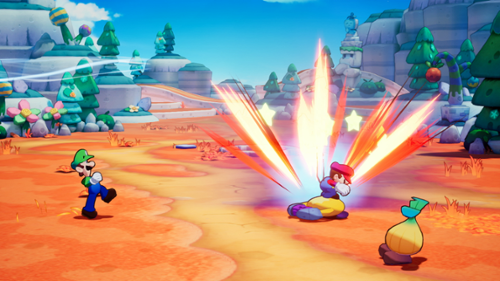
The enemy roster in Brothership is engineered around distinct movement traits, telegraph patterns, and corruption states. Enemies vary from basic local wildlife on Concordia's drifting islands to heavily armored bosses infected by Glohm corruption. Glohm corruption alters base enemy stats, increasing attack speed, granting armor plating, and introducing non-standard timing windows to familiar attack animations.
To break through complex enemy encounters, players must observe wind-up animations, weapon adjustments, and subtle visual cues. Many late-game enemies feature fake-out animations designed to trick players into jumping or swinging hammers early, leaving them exposed to secondary follow-up hits.
Categorical Enemy Weaknesses and Specialist Plugs
Enemies fall into structural classifications: Airborne, Grounded, Spiked, Armored, and Glohm-Infected. Attacking a spiked enemy with a basic Jump without protection results in recoil damage to the brother. Specialized Battle Plugs modify these rules, allowing players to bypass standard target restrictions:
- Anti-Spike Specialist: Nullifies jump recoil damage against spiked targets while granting critical strike chance.
- Anti-Flying Specialist: Forces airborne enemies to the ground, disabling their aerial evasion bonuses.
- Anti-Glohm Specialist: Strips Glohm armor plates faster, allowing direct damage to reach the core health pool.
Deconstructing Glohm Corruption Mechanics
Glohm-infected targets introduce unique combat rules. Attacks from Glohm enemies can inflict the Glohm status condition on the Mario Bros., lock out specific battle options (such as Bros. Attacks or Item usage), and cause passive health drain. Clearing Glohm ailments requires using specialized items like Ampberries or maintaining defensive execution to prevent infection buildup.
Boss Design Philosophy: Multi-Stage Mechanics and Arena Control
Boss battles in Mario & Luigi™: Brothership serve as comprehensive tests of the player's mechanical precision, plug selection, and spatial navigation. Bosses feature multi-phase health pools, mid-battle form changes, and environmental phase shifts that fundamentally alter the rules of combat. These encounters demand active tactical adaptation rather than simple damage output.
During boss encounters, target hitboxes often change position or lock behind sub-targets, such as protective shields or summoned minion waves. Players must balance single-target burst attacks with multi-target crowd control to manage the field while making steady progress against the main boss.
Phase Transitions and Dynamic Telegraphing
As a boss's health crosses specific thresholds, their attack patterns grow more complex. Phase transitions introduce faster attack telegraphs, multi-hit counter sequences, and arena hazards that require synchronized jumping from both Mario and Luigi.
Understanding visual telegraphing becomes vital during these transitions. For instance, a boss might glance at a specific brother before attacking, shift its weight to indicate a delayed strike, or raise a weapon to telegraph a sweeping attack that requires precise jump timing. Recognizing these subtle indicators allows players to preserve their HP and execute counter-attacks consistently.
Break Systems and Stun Windows
Many major bosses feature a 'Break' mechanic tied to specific body parts or protective barriers. Targeting these weak points using high-impact Bros. Attacks or contextual Luigi Logic interactions breaks the boss's guard, placing them in a stunned state for a limited number of turns.
During a stun window, the boss's defense stat drops significantly, and all landing attacks guarantee critical hits. Maximizing damage during these windows requires setup: stacking high-damage Battle Plugs, restoring BP ahead of time, and opening up with Mario's strongest single-target attacks.
Resource Management and Turn-Economy Efficiency
Managing turns efficiently is the defining factor separating basic progress from optimal combat performance in Brothership. The turn economy rests on three primary resources: Health Points (HP), Bros. Points (BP), and active Battle Plug charges. Every action carries an opportunity cost; spending a turn using a Mushroom or Syrup Jar delays damage output, extending the battle and granting enemies additional chances to land attacks.
High-level combat relies on minimizing defensive turns by using reactive counter-attacks and passive equipment skills for healing and resource recovery. By shifting health restoration onto passive plug effects—such as *High-Heal Boots DX* or *Gobblick Boots*—players free up character turns strictly for offensive setup and execution.
Turn Optimization Matrix
The following steps outline the setup loop for maintaining combat control during major encounters:
Step 1: Opening Control Phase
Evaluate enemy types and equip specialist Battle Plugs. Use high-speed gear on Mario to secure the first turn, applying target-wide status ailments like Burn or Dizzy via Kaboom combinations.
Step 2: Resource and Shield Breakdown
Target enemy armor or weak points using targeted Bros. Attacks. Use Luigi's turns to trigger contextual Luigi Logic pathways or set up party-wide stat buffs.
Step 3: Stun Execution Window
Once the target is stunned or broken, activate high-charge offensive plugs such as *Surprise Iron Boost*. Spend remaining BP on maximum-tier Bros. Attacks to deal massive burst damage.
Step 4: Cooldown and Recovery Cycle
While primary plugs recharge, shift to basic timing-perfect Jump and Hammer attacks to generate bonus item drops, rebuild meters, and maintain active counter-attack readiness.
Mastering the Synergy Mechanics in Mario & Luigi™: Brothership
The combat architecture of Mario & Luigi™: Brothership stands as a remarkably refined turn-based system, successfully blending real-time action mechanics with strategic build crafting. By linking timing precision, spatial awareness, Battle Plug customization, and Luigi Logic into a cohesive framework, the game elevates dual-character combat to new heights. Players who take the time to master its underlying mechanics discover a deep, satisfying RPG system where strategic preparation and execution go hand in hand.
Ultimately, Brothership proves that turn-based combat can remain energetic, strategic, and deeply engaging. Mastering its systems requires more than simple stat grinding—it demands complete synchronization between both brothers on the battlefield. Whether optimizing turn loops, crafting complex Battle Plug synergies, or executing precise frame-perfect counters, the journey through Concordia highlights the lasting strength of dynamic team-based RPG design.